Language: English

A Novel Scheme for a Pentapolarization Weather Radar Antenna Feed System

A Novel Scheme for a Pentapolarization Weather Radar Antenna Feed System

Abstract: Weather radar is currently evolving towards acquiring multi-polarization information. This paper proposes a novel scheme for a pentapolarization dual-channel weather radar antenna feed system, which conveniently achieves five polarization operating modes through a "Pentapolarization Switch Assembly". A design example for a C-Band 3.2-meter antenna is provided, demonstrating that this design scheme is novel and feasible.


Keywords: Motorized Pentapolarization Switch, Rotary Joint, Directional Coupler, Circulator, High-Power Load, Orthomode Transducer (OMT), Multimode Feed, Low-Sidelobe Antenna.

1.) Overview
Target information for weather radar is highly complex. The collection and analysis of information from different polarizations is key to further improving weather radar performance. Multi-polarization information processing is a crucial feature of new-generation Doppler weather radars. This paper proposes a novel pentapolarization weather radar antenna feed system. Utilizing only a single transmitter and a specially developed motorized pentapolarization switch, the radar can switch between five distinct polarization operating states: Horizontal Polarization (H) transmission, Vertical Polarization (V) transmission, Simultaneous H and V transmission, Left-Hand Circular Polarization (LHCP) transmission, and Right-Hand Circular Polarization (RHCP) transmission. Furthermore, under these five transmission modes, the receivers can separately or simultaneously receive target echoes in both H and V polarizations. The main features of this antenna feed system are: high-power handling, low loss, dual-channel operation, convenient multi-polarization state switching, high polarization isolation, low sidelobe levels, and high reliability.

2.) Problem Statement
Weather phenomena result from a complex combination of celestial, atmospheric, and anthropogenic factors. For any given region, weather conditions can change rapidly. Industrial and agricultural activities, transportation, tourism, maritime and aviation operations, aerospace and military endeavors, human life and survival, as well as understanding Earth's evolution and predicting its future, all rely heavily on meteorological research. Nations worldwide invest significant resources in this field.
Weather radar has developed based on the backscattering properties of microwave signals from meteorological targets such as clouds, rain, wind, and fog in the near-Earth atmosphere. Growing research indicates that the backscattering characteristics of weather radar targets are extremely complex parameters. Due to their unique composition and intricate structures, these characteristics are very difficult to model using simple mathematical analysis. Therefore, acquiring target reflection data across more frequencies and more polarizations forms the foundation for further research into target properties. This paper addresses this need by proposing a novel, feasible, and readily implementable scheme for the design of multi-polarization weather radars.

3.) Pentapolarization Antenna Feed System Design
To meet the requirement of transmitting in five polarization states, the antenna feed system could employ either a single-channel or a dual-channel transmission approach. However, besides the five-polarization transmission requirement, this radar also requires that two orthogonal receivers be capable of simultaneously or separately receiving target echo signals under all five polarization states, thereby obtaining more information. Consequently, this antenna feed system must adopt a dual-channel transmission scheme.
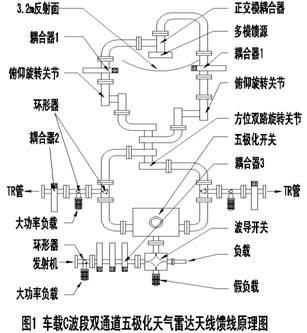
For this purpose, we specifically designed a Pentapolarization Switch Assembly. The pentapolarization antenna feed scheme is realized through a dual-channel transmission system and a dual-polarization radiating antenna system. A schematic diagram of the antenna feed system is shown in Figure 1 on the following page.

4.) Operating Principle of the Pentapolarization Antenna Feed Scheme
The dual-channel pentapolarization weather radar antenna feed system consists of a transmitter protection unit, a transmitter and feed/antenna monitoring unit, a feed network, a polarization conversion unit, and a dual-polarization antenna.
The radar transmitter protection unit is comprised of a three-port circulator and a high-power load. It protects the transmitter from potentially abnormal high reflections originating from the antenna feed system.
  The monitoring and detection device for transmitters and feeder antennas is implemented using multiple couplers, waveguide switches, dummy loads, and monitoring instruments. Common monitoring instruments include pulse power meters, spectrum analyzers, detectors, and oscilloscopes. To simultaneously monitor various signals, sampling couplers may have 3 to 6 or even more ports, with coupling directions including forward and reverse. Forward coupling monitors the transmitted signal, while reverse coupling monitors the reflected signal from the feeder antenna, i.e., monitoring the system voltage standing wave ratio (VSWR) of the feeder antenna. When abnormal faults occur in the antenna feeder system, the reflected signal exhibits specific variations. Couplers can directionally detect parameters such as return loss, transmission loss between two signal paths, and phase consistency to assist in judging whether the feeder system is operating normally and to monitor the effectiveness of troubleshooting. Waveguide switches are used to control whether the radar operates in its actual working state or in a transmitter testing state (by redirecting the transmitter signal toward the dummy load).

  The feeder system’s power-feeding device consists of components that form two channels connecting the triple-polarization state switching switch and the dual-polarized feed source. These include a four-port circulator, a TR discharge tube, a limiter forming the transceiver duplexer, a dual-channel azimuth rotary joint, an elevation rotary joint, sampling couplers, and straight, bent, and twisted waveguides of varying lengths. The azimuth rotary joint and elevation rotary joint are critical components that enable normal power transmission to the antenna as the entire system rotates in azimuth and elevation directions. Sampling couplers can measure or monitor the transmission loss and phase consistency between the two signal paths, assisting in determining whether the feeder system is operating normally.

  The polarization conversion device is realized through a specially designed five-polarization state switching switch assembly developed by Hengda Company. When the transmitter signal is switched to horizontal polarization, the transmitted signal is channeled through the H path to radiate via the antenna’s H polarization. When the transmitter is switched to vertical polarization, the transmitted signal is channeled through the V path to radiate via the antenna’s V polarization. When the transmitter is switched to H and V dual polarization, the transmitted signal is equally divided and fed in-phase through both the H and V channels to radiate simultaneously via the antenna’s H and V polarizations; in this case, the actual radiation corresponds to a 45° oblique polarization wave. When the transmitter is switched to left-hand or right-hand circular polarization, the transmitted signal is equally divided and fed in quadrature through the H and V channels to radiate via the antenna’s H and V polarizations. When the phase difference between the electromagnetic waves is +90°, the actual radiation corresponds to a left-hand circularly polarized wave; when the phase difference is -90°, the actual radiation corresponds to a right-hand circularly polarized wave. Thus, conversion among five polarization states—horizontal polarization, vertical polarization, 45° oblique polarization, left-hand circular polarization, and right-hand circular polarization—is achieved. Under all five polarization states, both H and V channel receivers can receive echo signals either separately or simultaneously.


Thanks to the adoption of the "five-polarization state switching switch assembly" invented by Hengda Company, the layout volume of the feeder has been substantially reduced, while the amplitude and phase consistency issues in the two-channel signal transmission have been better resolved, resulting in more user-friendly operation.

5.) An Example of a C-Band Five-Polarization Antenna Feeder System
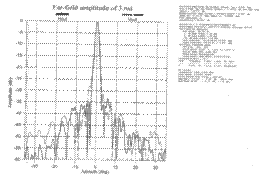
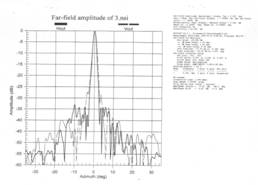
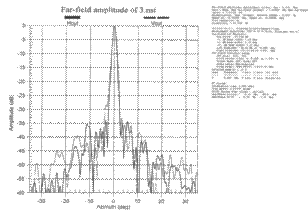
A practical example of a C-band five-polarization antenna feeder system has been developed. The technical specifications and measured data of this antenna feeder are recorded in Table 1, while the measured antenna radiation pattern is shown in Figure 2. The symbols used in this document are also listed in Table 1.


表一


系统参数

指标要求

天线参数

指标要求

实测结果(F-;F0; F+)

工作频率

C波段

天线口径

≥3.2m

3.2m

峰值功率容量

≥300kw

增益

≥41dB

42.04dB;42.2dB;42.5dB

平均功率容量

≥300w

波束宽度

≤1.3°

方位:1.24°—1.36°
俯仰:1.23°—1.4°

工作模式
(单发射机)

H发,H&V收;
V发,H&V收;
H&V发,H&V收;
L发,H&V收;
R发,H&V收;

第一副瓣

≤-26dB

1口方位

-27.76dB;-29.26dB;-29.88dB

1口俯仰

-31.34dB;-33.8dB;-32.27dB

2口方位

-34.42dB;-33.5dB;-34.02dB

2口俯仰

-28.53dB;-28dB;-28.5dB

交叉
极化电平

≤-30 dB

-31.8dB;-31.6dB;-31dB


在各种极化状态下

波束主轴方向差≤0.1°,
增益差≤0.3dB

波束主轴方向差≤0.01°,
增益差≤0.065dB


圆极化轴比

≤1.5dB

1.58dB(可望提高到1dB)

符号

说明

馈线参数

技术指标

实测结果

H

水平极化

天线馈线
系统VSWR

≤1.5

还没有全部连接起来测

V

垂直极化

馈线系统
隔离度

≥40dB

≥61.089dB;
≥63.943dB

L

左旋圆极化

收发隔离度

≥30dB

≥30dB

R

右旋圆极化

方位双路
铰链插损

≤0.3dB

0.17dB;0.18dB


方位双路
铰链转动
插损差起伏

≤0.1dB

≤0.01dB;0.05dB


铰链转动
相位差起伏

≤3°

≤0.71°;≤0.90°


Contact Us

Superb Automation Co., Limited

Website:www.superb-tech.com

For 25 years your reliable partner in Electronics & PCBA!

HK number: 85260404363

Email :Info@superb-tech.com

Whatsapp:8613396081443