Language: English

Cushion Attenuator and Its Applications

Cushion Attenuator and Its Applications

  Pad attenuators,also known as fixed attenuators with low input and output VSWR and good frequency response,are available in coaxial and waveguide types. Coaxial attenuators are more common in the market, while waveguide attenuators are less so.This article introduces the superior performance of the wave guide pad attenuator developed by the Microwave Technology Development Department of the 206th Research Institute of the Ministry of Machinery and Electronics Industry and its applications in microwave and measurement systems.


I. Pad Attenuators

Pad attenuators are fixed attenuators with low input and output VSWR and good frequency response. They are available in coaxial and waveguide types. Based on attenuation principles, they can be classified as resistive, absorption,power-dividing, and coupling types.

Pad attenuators are commonly used for signal level control, protecting devices or equipment from damage by high signal power, ensuring their normal operating level, reducing mutual coupling and mutual pull between devices, eliminating or reducing the input VSWR of a certain part of a microwave system, and serving as a substitute standard in microwave measurements such as gain, attenuation, and return loss using the partial high-frequency substitution method.Therefore,pad attenuators are essential components in microwave engineering and microwave measurement.

Common coaxial pad attenuators on the market typically offer attenuation values of 3,6,10,15 and 20 dB, while waveguide pad attenuators are less common. Our developed AC-type waveguide pad attenuator fills this market gap. Furthermore, due to the use of a special bulk absorbing material, the attenuation—frequency response—across the entire waveguide bandwidth is improved from ±1.6 dB to ±0.8 dB. A typical measured value is ±0.5 dB.


II. AC-type Waveguide Pad Attenuator

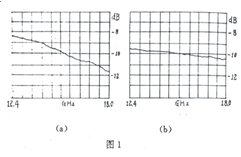
Traditional waveguide attenuators use sheet-like absorbing material placed parallel to the electric field direction within the waveguide. Attenuators made using this method have a frequency response of approximately ±1.6 dB across the entire waveguide bandwidth, as shown in Figure 1(a). Our attenuator uses a bulk absorbing material that fully fills the waveguide, achieving a frequency response of <0.8 dB across the entire waveguide bandwidth, with a typical measured value of ±0.5 dB, as shown in Figure 1(b). Other parameters are:

Attenuation: 3, 6, 8, 10, 15, 20 dB, or user-specified values.

Frequency range: 2.6–40 GHz full waveguide bandwidth.

Attenuation frequency response: ≤ ±0.8 dB; typical value ≤ ±0.5 dB.

Input and output VSWR ≤ 1.15; typical value ≤ 1.10.


  The above describes the absorption-type waveguide pad attenuator. For the coupled type, its performance is:Attenuation frequency response: ≤ ±0.6 dB.

  Input and output VSWR ≤ 1.07, and can be as low as 1.04.

  It can be seen that the coupled type has excellent frequency response and VSWR, but its size is larger.


III. Applications of Pad Attenuators

  1. Used for signal level control

  In amplifier experiments or tests, there are certain requirements and limitations on the input signal level. When the input signal level approaches or enters the gain compression region, the amplifier saturates. Referring to Figure 2, assuming the amplifier's 1dB gain compression point is PIon = adBm, and the actual input signal level is Pon = bdBm, then using a pad attenuator with an attenuation of At1 > (b - a + 1) dB will ensure the amplifier does not operate in the saturation region.

  When detecting or monitoring high power levels, power probes (power mounts), current detectors, or detectors are commonly used. These devices themselves have a power capacity limitation. To ensure the normal operation of detection and monitoring, pad attenuators can be used to control the signal power level input to these devices, as shown by At2 in Figure 2.

  In systems with such signal level limitations, pad attenuators are your best assistant.

  2. Reducing Mutual Coupling and Inter-device Pull-in

  In microwave systems, mutual coupling, leakage, crosstalk, harmonics, or other stray coupling between certain devices can cause the system to malfunction, degrade system performance, or drastically reduce measurement accuracy. In such cases, inserting a pad attenuator at an appropriate location in the system can improve the isolation between channels or reduce mutual coupling and interference between devices, thus ensuring normal system operation or improving measurement accuracy.

  As shown in Figure 3(a), At1 and At2 in a dual-channel system effectively improve the isolation between the two channels and reduce channel crosstalk. Figure 3(b) shows a common slotted measurement line system, where At1 reduces the mutual coupling between the source and the DUT, eliminating the influence of the reflected signal from the large-reflection DUT on the frequency and power of the source, and improving source matching.


  3. Improving Matching

  If the VSWR viewed from a reference plane of a system towards the load is unsatisfactory or affects the normal operation of the system, a pad attenuator can be used to reduce its input VSWR.

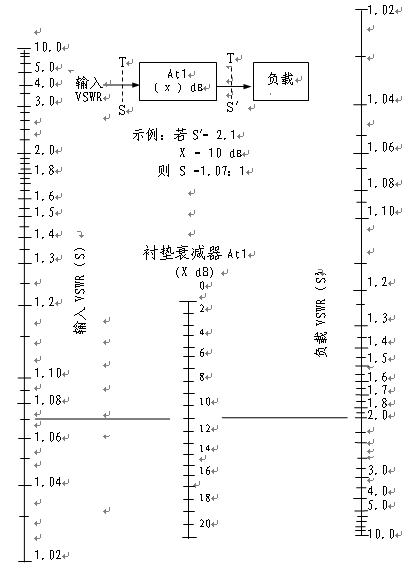
  Referring to Figure 4, let the VSWR viewed from the reference plane T' towards the load be S'. After connecting At1 in front of it, its input VSWR becomes S. Therefore, given S' and the desired value of S, the attenuation of At1 can be obtained from the noctilinear diagram in Figure 4. Conversely, if S' and the attenuation X (dB) of the pad attenuator are known, S can be calculated from the nomograph.


 Of course, when the calculated S < the input VSWR of the pad attenuator, the input VSWR viewed from the reference plane T towards the load direction is the attenuator's own input VSWR.

In Figure 2, At1 protects the sensing device from being burned out by high power levels and also improves the matching of the sensing device.

In the measurement of low-loss devices, some incredible results are often obtained. For example, a straight waveguide with an actual loss of less than 0.2dB can sometimes show a gain of nearly 1dB. This is a typical mismatch error.

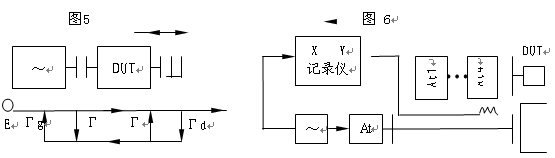
The signal flow graph in Figure 5 illustrates the quantitative relationship of this mismatch error.

According to the basic rules of the signal flow diagram, the signal Vd at the detector input can be directly obtained:

Vd=T[1±(ГГg+ГГd+Г2ГgГd)]=T(1±△)…………………………………(1)

In the formula, each quantity is a vector.

△=ГГg+ГГd+Г2ГgГd………………………………………………………(2)

T and Г are the transmission coefficient and reflection coefficient of the device under test, respectively; Гg and Гd are the reflection coefficients from the device under test towards the source and towards the load, respectively. T is the quantity to be measured.


When T≈1 and Г<0.03, that is, when the input and output VSWR of the low-loss device under test is <1.06, we examine Гg and Гd to determine the large measurement error that may occur in the measurement of low-loss devices. For ease of analysis, let |Гg|=|Гd|, and substitute it into equation (3) for calculation.

Amax= 20lg[1±|△|]

= 20lg[1±(|ГГg|+|ГГd |+|ГgГd |)]

  Table 1 gives the values ​​of △Amax when Гg and Гd are different. It can be seen from this that when measuring small losses, special attention must be paid to the influence of Гg and Гd, rather than the advancement of the measuring equipment. In addition, poor connection of the connector may also introduce a measurement error of about 0.2dB. △Amax is only the maximum possible measurement error. In fact, the probability that the three terms in △ and T are all in phase or out of phase is very small. Therefore, the actual error can be estimated by △Amax/3.

|Гg|=|Гd|

△Amax(dB)

反射系数

对应的VSWR

+

-

0.3333

2

1.068

1.218

0.286

1.8

0.820

0.905

0.20

1.5

0.440

0.436

0.13

1.3

0.212

0.217

0.091

1.2

0.119

0.120

0.07

1.15

0.079

0.079

0.047

1.10

0.044

0.044

0.03

1.06

0.023

0.023

  4. Used as a substitute standard in the measurement of "partial high frequency substitution method"

  This application of the pad attenuator is rarely introduced. As is well known, high-frequency substitution measurement can eliminate detector law errors and amplify the switching and nonlinear errors of indicating devices. Therefore, it is frequently used in measurements of attenuation, return loss, and noise figure.

  High-frequency attenuation substitution standards in the waveguide band often employ rotating polarized precision attenuators. However, in some situations, due to the large size and weight of polarized attenuators, when testing conditions and space are limited and cannot be set up and used, or when polarized attenuators are unavailable, the partial high-frequency substitution method proves invaluable due to its lightweight substitution standard and convenient connection.

  The partial high-frequency substitution method refers to a simple method where the substitution values ​​are not comprehensive, or where substitution can only be performed on some specific values. It completes all measurement readings together with the direct measurement method. For example, Figure 6 shows a swept-frequency reflectometer using the partial high-frequency substitution method. During calibration, a short circuit is connected to the measurement port. Pad attenuators with attenuations of 15, 20, 25, and 30 dB are inserted between the detector and the coupler, and four calibration lines are recorded on the recording device. These four calibration lines represent VSWR values ​​of 1.43, 1.22, 1.12, and 1.07, respectively. Then, remove the attenuator and short-circuit, replace the device under test, and record the readings. The measured VSWR curve can then be interpolated against the calibration lines. If the test is only to verify whether a certain performance indicator is met, a pad attenuator with an attenuation equal to or close to the return loss value of that indicator is sufficient.

  Partial high-frequency substitution measurements of attenuation or gain are performed in the same principle and method as described above. The standard mismatch load calibration method is also a partial high-frequency substitution method.


Contact Us

Superb Automation Co., Limited

Website:www.superb-tech.com

For 25 years your reliable partner in Electronics & PCBA!

HK number: 85260404363

Email :Info@superb-tech.com

Whatsapp:8613396081443